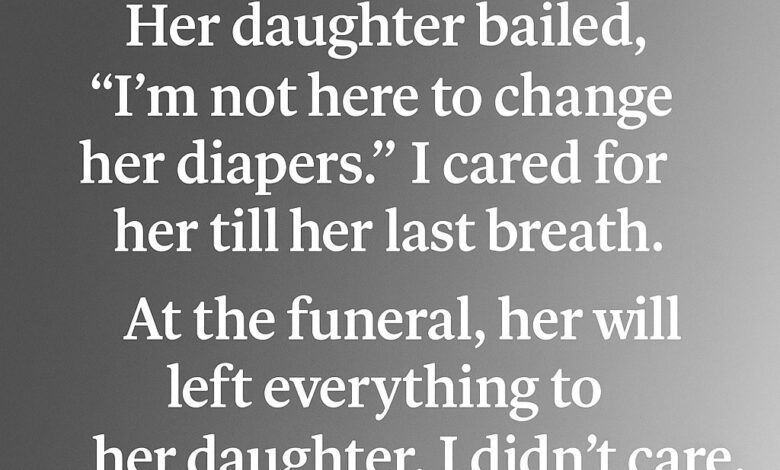
My stepmom spent her final months in a vegetative state, and while her daughter refused to help—“I’m not here to change her diapers”—I stayed by her side until her last breath. At the funeral, everything in the will went to her daughter. I didn’t care. I never cared about the inheritance.
The next day, her daughter called, sobbing and furious. The house she inherited was collapsing, filled with medical equipment, unpaid bills, and the heavy truth she’d avoided: she hadn’t been there. Her anger wasn’t about property—it was guilt she had no idea how to carry. She demanded to know why her mother had “burdened” her. I just listened. There was nothing to fix this time.
In the days that followed, I replayed the quiet moments I’d shared with my stepmom: brushing her hair in the mornings, speaking to her as nurses and I repositioned her gently, holding her hand the night she passed. Caring for her had been love, not duty. And I knew her daughter’s absence had hurt her, even if she never said it.
When her daughter asked to meet, she looked smaller, softer. She apologized—slowly, then all at once. She admitted she hadn’t been able to face her mother so helpless. She envied the closeness we had. We talked for hours, sorting papers and finding old photos that made us smile through the grief.
In the end, she sold the house and donated part of the money to the care facility. As she hugged me goodbye, I realized the real inheritance wasn’t the house—it was the fragile bridge my stepmom left behind, allowing us to finally meet in the middle.