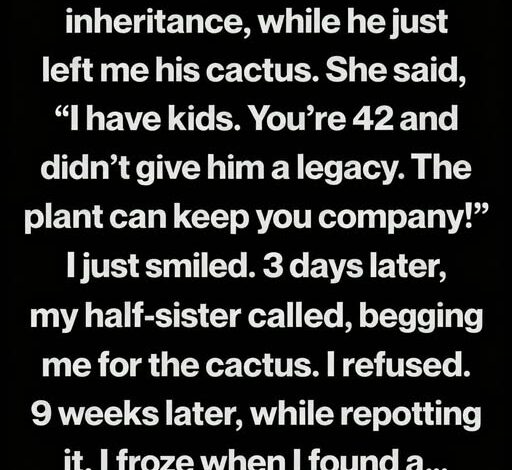
When my father passed away, grief didn’t crash over me—it settled quietly into daily life. At the will reading, my half-sister inherited the house, savings, and everything of clear value. I received one thing: his old cactus, the same plant that had sat by his window for years. She laughed, saying she had children to support and that I, at 42, would be fine with something small. I didn’t argue. I took the cactus home and placed it on my kitchen table, choosing to see it as a final, quiet gift from a man who never spoke easily.
In the days that followed, I realized how much the cactus reflected him. He’d always admired its resilience—how it survived with little care and still kept growing. Three days later, my half-sister called, suddenly softer, asking if I would give her the cactus after all. I declined. Not out of spite, but because it felt personal—untouched by money or disputes.
Weeks later, while repotting it, I noticed something wedged near the roots. Inside the soil was a small, sealed envelope. It held a handwritten note from my father. He wrote about his flaws, his regrets, and how proud he was that I’d built a life rooted in kindness rather than expectation. The cactus, he explained, was never “just a plant,” but a reminder that true worth isn’t obvious.
I never told my half-sister about the note. That message was meant for me. The cactus still sits by my window, quietly growing—proof that the most meaningful legacies often come in the smallest, unexpected forms.